
ADHD Bingo Card: 20 Real Patterns That Expose How ADHD Actually Shows Up

TLDR: Most ADHD bingo cards track forgettable moments or focus on validating how you feel. This one focuses on recurring behaviors you’ll actually recognize, without the added pressure of trying to remember .
When I first heard of mental health-related bingo cards, I was genuinely confused. How did a childhood game that I played with my grandmother have anything to do with ADHD, especially for an adult woman?
After digging a bit, I was surprised to learn that themed ADHD bingo can be used as a low-effort way to track recurring behaviors or symptoms. When it’s difficult to consciously and consistently remember to keep notes or check off a list each day, bingo is a quick and fun way to do so.
If you’ve spent time in any online self-help group that centers on neurodivergence, you may have come across the technique of gamification. Gamification turns a difficult or unenjoyable task into a game by adding points, rules, competition, and challenges around the task. This process is easier to maintain than trying to recall specific moments or keep a detailed journal.
How to Play ADHD Bingo
The card is designed to work without perfect memory or daily commitment. Mark what stands out when you can, and patterns will emerge on their own. Here’s how it works:
- Keep the card visible. Set it as your screensaver or screenshot the blank version for easy access.
- At the end of the day (or whenever you remember), mark what actually happened. You don’t need to overthink it because you’re not tracking every instance, just the things that genuinely affected you.
- Play a few times a week, and in a month you’ll have real data to work with or reflect on.
What’s on the Card
The ADHD bingo card is divided into five life areas: daily self-care, time and tasks, relationships, home and environment, and mental or emotional patterns.
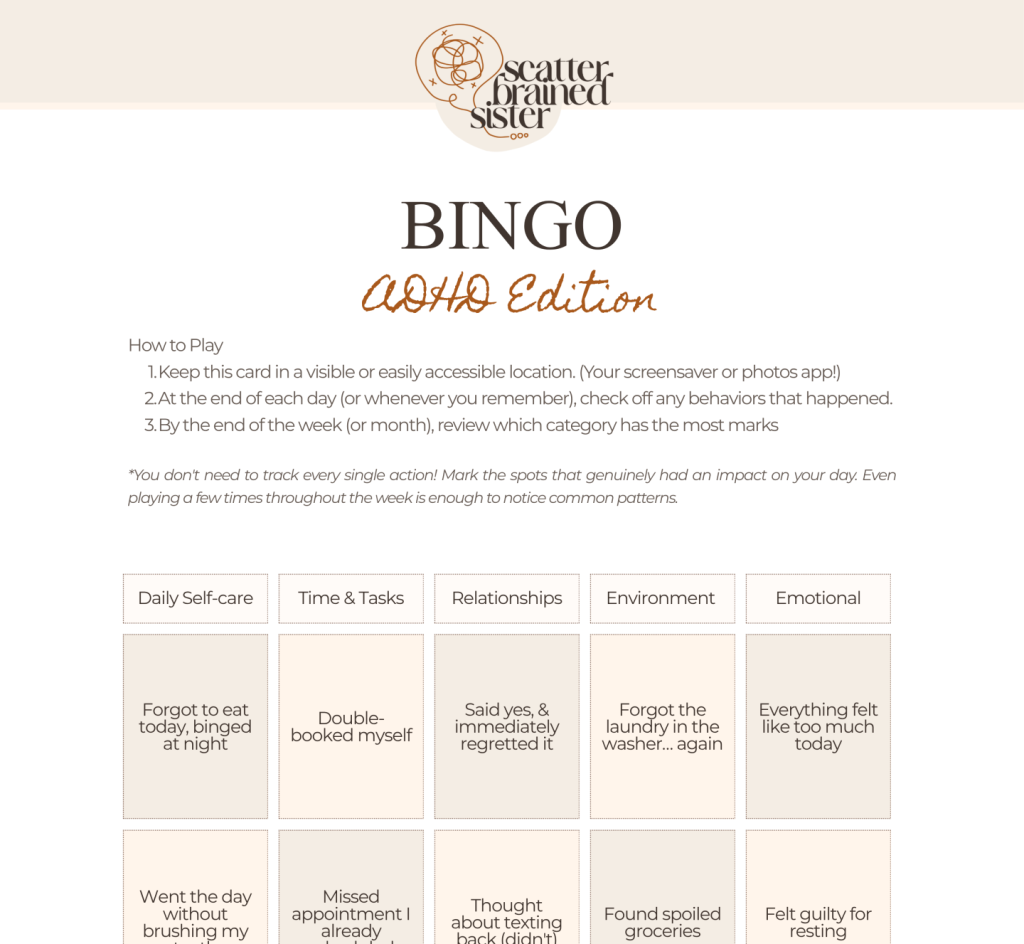
👉 Grab the free ADHD Bingo card and see which symptoms show up most for you
Daily Self-care
Self-care with ADHD is about closing the gap between knowing you need to do something to care for yourself while your brain struggles to start or maintain the task. These squares reflect self-care tasks that may pile up and then feel heaviest at the end of the day or week.
- Forgot to eat today, binged at night
- Went the day without brushing my teeth
- Wore the same clothes multiple days
Time & Tasks
Time blindness may seem like just running late, but in truth, it’s the collapse of your sense of how long things take, how many things you’ve committed to, and why none of them got done. These are the moments that make you feel like you’re constantly behind, even when you swore you planned.
- Double-booked myself
- Missed appointment, I already scheduled
- Planned it all out, didn’t start
Relationships
ADHD often impacts our relationships in ways that are hard to explain without sounding like excuses. These squares capture the social friction that can come from a scatterbrain that’s either everywhere at once or completely checked out.
- Said yes, & immediately regretted it
- Thought about texting back (didn’t)
- Overshared to fill the silence
Home & Environment
The state of your environment is a direct readout of your executive function on any given day. These help track what happens when initiation and follow-through break down consistently.
- Forgot the laundry in the washer… again
- Found spoiled groceries
- Did a panic clean before having company over
Mental/Emotional
This is the category most people don’t associate with ADHD, but emotional dysregulation is one of the most challenging symptoms for some. These squares reflect the internal experience that may not usually make it into a symptom checklist.
- Everything felt like too much today
- Felt guilty for resting
- Cried over something objectively small
Why Most ADHD Bingo Cards Miss the Point
The issue I kept running into when I downloaded a few of the ADHD bingo cards I found online was that most were full of stereotypical “oops, I forgot something” moments.
👉 Grab the free ADHD Bingo card and see which symptoms show up most for you
As someone with inattentive ADHD, I found it ironic and a bit infuriating.
Most cards were made to fill in yourself (hello paralysis!), require daily check-ins, and focus on making you feel seen, which may not be as productive for your pattern recognition.
Those bingo cards are good for commiserating over shared experiences, but not for symptom tracking, as they focus more on gamifying your to-do list rather than helping you notice what’s actually happening in your brain over time.
The problem is twofold: if you can’t remember things as they happen, you won’t remember them later to mark the card, and constantly pulling out your phone to play bingo isn’t always socially acceptable.
This ADHD bingo card focuses on behaviors impactful enough to stand out when you reflect, so you can mark them later without needing to track anything in real time.
Instead of isolated “oops” moments, the categories help you see which parts of your life your symptoms are quietly running.
What You’ll Actually Get Out of It
If you’re looking for a simple way to keep an eye on where your ADHD may show up most with little effort or memory, then this is the bingo card for you.
Playing even a few times a week helps clear up that feeling where everything felt difficult, but impossible to name.
- See which area of life ADHD is impacting you most this week
- Identify patterns you might not have connected before
- Know where to focus your energy when building new systems
- Validate that these struggles are real and worth addressing
- Track progress over time if you use it week after week
- Have concrete examples for therapy, doctor appointments, or explaining ADHD to others
Takeaway
This tracker makes it easy to catch recurring patterns through a simple, gamified ADHD bingo card.
Use it throughout the week, or as often as you remember, and mark what genuinely stood out. Instead of trying to log every moment, you’ll build a picture of where your ADHD shows up most, so that when everything feels hard but impossible to name, you have something concrete to point to.
Disclaimer: The content on Scatterbrained Sister is for informational and reflective purposes only and isn’t a substitute for professional medical advice, diagnosis, or treatment. Always consult your healthcare provider with questions about ADHD or any other condition. These experiences are personal and may not apply to everyone.