
ADHD Task Paralysis: 7 Brutal Truths + 5 Strategies That Actually Work

TLDR: ADHD task paralysis is a neurological freeze, not a motivation problem, and it looks different for everyone. These 5 strategies actually work with your brain instead of demanding something from it that isn’t there.
ADHD task paralysis is a specific kind of stuck that happens when you know what you need to do, can picture getting it done, and yet somehow you stay stuck. Your body refuses to move, and you find yourself rotting in the same spot for hours.
Even though it may look like laziness, it’s a truly different experience. On the outside, it may seem like you’re relaxing, but internally, there’s a voice screaming, “JUST GET UP!”
In my experience, ADHD paralysis feels like the world is burning down, and I cannot engage.
It’s already 9 PM, and a paper is due at 11:59, bills need to be paid while the money sits in my account, and sometimes it’s as simple as a video game I’ve been wanting to play for weeks… but I struggle to start any of it.
The anxiety about not doing whatever task grows by the minute, making it even harder to act. Shame piles on, and the cycle continues until either the deadline forces me to move or passes me by entirely.
Before we get into what helps, let’s talk about what’s really going on when you’re stuck.
What is ADHD paralysis?
ADHD paralysis is a breakdown in executive function, specifically in task initiation, or the brain’s ability to start or switch between tasks.
There are typically three types of paralysis:
- Mental paralysis (can’t think or process)
- Task paralysis (can’t start tasks)
- Choice paralysis (can’t make decisions)
Also driving the paralysis is the fact that ADHD brains are shown to have lower dopamine activity, which is essential for motivation and movement.
The common misconception about motivation is that it’s only related to enjoyment or sheer force of will (the ability to decide to do something). In reality, motivation refers to the brain’s ability to signal that basic, mundane tasks need to happen, like brushing your teeth, paying bills, or getting out of bed.

Someone without ADHD will instinctively wake up and brush their teeth, not because it’s fun or rewarding, but because their brain naturally produces the signal that it needs to be done.
For individuals with ADHD who experience executive dysfunction, that signaling is impaired, so there’s little to no natural drive to do these maintenance tasks, even if we intellectually know they’re necessary. In some cases, external forces fill the gap: anxiety, accommodations, deadlines, accountability, or the threat of immediate consequence.
ADHD Task Paralysis Symptoms
Task paralysis appears differently depending on the day, the task, and how depleted you already are. I find real-world examples more helpful than a straight symptom list, so here’s what it can look like:
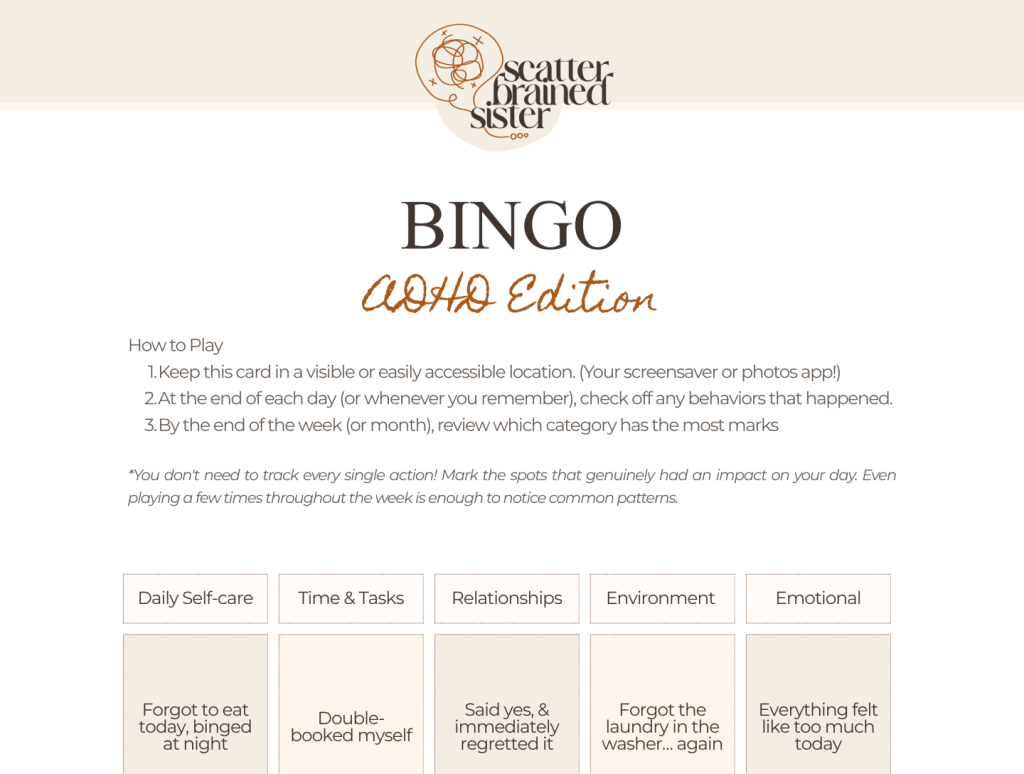
👉 Grab the free ADHD Bingo card and see which symptoms show up most for you
- You’re physically frozen, but your mind won’t stop racing through everything you need to get done.
- Too many tasks feel equally urgent, so you can’t choose where to start and end up doing nothing at all.
- Hours pass while you’re “busy,” but when you look up, nothing’s actually gotten done.
- Simple tasks like sending an email or making a phone call suddenly feel impossible.
- You struggle to switch between tasks, even when you want to move on to something else.
- You’re not just stuck physically, you’re also emotionally shut down or completely overwhelmed.
- Small logistical details like due dates, formatting, or where to submit something derail you completely.
- You need to talk through or write out a task before you can actually start it.
- You avoid tasks you’re good at or even enjoy because the initiation still feels impossible.
If any of that felt uncomfortably specific, it helps to understand what’s actually happening underneath.
ADHD Paralysis vs Executive Dysfunction
These two terms get used interchangeably, but they’re not quite the same thing. Executive dysfunction is the broader condition; ADHD paralysis is what happens when it peaks.

Executive function covers the skills that help us organize and manage daily life: planning, time management, working memory, emotional regulation, and the ability to shift between tasks. Executive dysfunction is when those systems break down. Planning falls apart, you lose track of time, you forget what you were doing mid-task, organizing feels impossible, emotions feel heavier than they should, and switching between activities takes more effort than it seems like it should.
ADHD task paralysis is what happens once that dysfunction reaches a tipping point.
When your executive function skills are already limited and then get overwhelmed by too much stimulus or too many competing priorities, or understimulated by a boring task with no immediate reward, you freeze. You have the intention and the knowledge, but you cannot coordinate your brain and body into actually doing the thing.
How to Get Out of ADHD Paralysis
Breaking your paralysis has nothing to do with willpower or discipline, which is probably why the advice that works for everyone else leaves you feeling like you’re falling short. The strategies that actually move the needle probably won’t show up in a generic self-help article. Here are 5 ways to get unstuck.
Pair tedious tasks with stimulation
Sitting in silence and trying to push through never works for me. I need something else going on at the same time: music that matches the energy I’m trying to access, or a show I’ve already seen playing in the background. Sometimes I throw on my wearable blanket and over-ear headphones to wash dishes, and I can finish everything in the span of a single video essay.
Extra sensory input gives the mind something to engage with instead of wandering off or shutting down completely.
It’s not enough to just have something on, though. The key is intentionally pairing specific stimulation with specific tasks, so it actually triggers the mood or headspace you need, or eases whatever resistance is making you avoid the thing in the first place.

Manufactured motivation where you naturally lack it is the whole point. Depending on the task, these tiny adjustments are the difference between being able to start and staying frozen for hours.
Specific environments for specific tasks
Be more intentional about where you do what. My bed is only for sleep (and honestly, scrolling… I’m working on it), my desk is for creative work and admin tasks like paying bills or responding to emails.
Along with the set location, I have specific playlists or podcasts I only listen to during that time.
It sounds rigid and obvious, but assigning spaces removes a layer of decision-making. Your brain already knows “this is where I do this kind of work,” so task initiation gets a little easier because you’re naturally primed before you even sit down.
Adding novelty, the right stimulation, and consistency is the most important piece of making this work.
Sometimes I’ll work at a specific cafe or library a couple of times a week if I’m feeling frozen at home and really need to get something done. The change in environment gives me something new to engage with and breaks through paralysis when the usual spots aren’t cutting it. Being around other people working makes it easier to start, even if I never talk to them.
I’m way less likely to revert to YouTube videos and a nap when I’m not on my couch.
Rituals, not routines
Routines feel like obligations I’m constantly failing at. I refuse to even use the word routine at this point; I think I’m allergic.
Rituals are sequential daily actions that you actually choose to do and look forward to. Hear me out, it’s not just semantics.
I don’t have a morning routine; I have a morning ritual where I make coffee a specific way, use my favorite fresh ingredients for a simple breakfast, sit in a specific spot under the sun, and check my phone or read before I do anything else. Even more important for the way I function, there’s no specific time or part of the day these things need to get done.

When I need to do something boring like paperwork, I’ll turn it into a ritual by lighting a candle, putting on a specific playlist, and setting everything up in a way that feels purposeful, which tricks my brain into thinking this is something worth doing instead of just another task on the list.
The ritual part makes it feel intentional instead of like another thing I’m supposed to do perfectly.
Lower the bar
When it’s hard to start something, trying to just push through is usually a setup for failure.
Instead, there are a few ways to lower the bar while still getting through your to-do list. Comfort and stimulation don’t always help when the issue is overwhelm. Spreading the task across multiple days and working within specific categories are the two most dependable ways to lower the bar.
If the dishes pile up, I’ll categorize the items by putting all cups together, all bowls together, pans separately, and for some reason, the physical clarity helps me mentally sort through the tasks. If that’s still not enough, I’ll spread them by category over multiple days. Cups on Monday, bowls on Tuesday, and so on.
This isn’t a planned process, by the way, it’s just going through whichever categories work for the day. Sometimes you’ll end up pushing through and finishing everything at once, but even if that doesn’t happen, you still did something, and something is the whole point.
Set systems that remove friction
I can’t trust myself to make good decisions in the moment when I’m already depleted, so I’ve built systems for those times that remove decisions entirely.
My keys have one designated spot by the door where I would naturally drop them. There’s a default outfit rotation for the week in a basket, so mornings don’t involve standing in front of my closet trying to decide what to wear or creating a clothing pile. A few ingredients stay prepped, so feeding myself doesn’t require the motivation and energy that isn’t there.

Reducing daily decisions preserves executive function for tasks that actually matter.
Anything that can run automatically without requiring memory or initiation gets set up that way, and the less that needs active management, the more bandwidth stays available for the things that actually need it.
Living With ADHD Task Paralysis
None of this works all the time. I’ve had plenty of days where I do everything right and still end up stuck in the same spot for hours.
How much sleep you got, what you’ve already dealt with that day, diagnosis severity, medication, all of it affects what capacity is left, and you can’t always predict it.
These strategies don’t fix everything or make the paralysis disappear, but they narrow the gap between wanting to do something and actually getting it done. Some days we need that extra help just to get through basic stuff, and that’s ok.
Getting diagnosed late meant spending years convinced I was worse at managing life than everyone else. A medical explanation doesn’t undo that, but it changes what the frozen moments mean, and some days that’s enough to stop the spiral.
Disclaimer: The content on Scatterbrained Sister is for informational and reflective purposes only and isn’t a substitute for professional medical advice, diagnosis, or treatment. Always consult your healthcare provider with questions about ADHD or any other condition. These experiences are personal and may not apply to everyone.