ADHD in Women Checklist: 15 Signs You Might Have Missed

TLDR: ADHD often goes undiagnosed in girls and women because our symptoms frequently present differently from hyperactivity. This ADHD in women checklist uses everyday language to help you recognize patterns you might have been dismissing as personal failures, so you can decide if it’s worth seeking professional evaluation.
I’m 27, and over the last 10 years, I’ve lost every ID and physical card I’ve been issued. I’ve broken down crying in parking lots because I couldn’t find my car for an hour (a hilarious story to share now, but I was genuinely devastated in the moment). I’ve even shown up a day early for appointments multiple times, only to arrive sweaty and out of breath at the last minute when the actual scheduled day rolls around.
At one point in my life, these curiously common mishaps felt like personal failures that made me uniquely incompetent at adulting.
Before my primary inattentive ADHD diagnosis (historically called ADD), I’d come across the symptoms littered online: impaired working memory, executive dysfunction, and emotional dysregulation.
My legs worked fine, so I felt functional enough. I wasn’t throwing visible tantrums in front of others, which I figured meant I had reasonable emotional regulation. It’s comical to write out now, but growing up without any real mental health awareness and a limited understanding of disability left me feeling lost.

The clinical explanations didn’t fit what I was experiencing – or at least, I couldn’t see myself in them. It was only through online forums and communities created by ADHDers that I saw my lived experience replicated in too many posts to ignore, all described in simple, everyday terms.
It’s for this reason that I created the ADHD in Women Checklist, which describes both commonly known and less often considered symptoms in language that’s relatable and easily understood.
Why Many Women Don’t Recognize Their ADHD Symptoms
Part of why I couldn’t relate to the symptoms described online is that it took me a while to learn that there are three types of ADHD. The most common presentation found in girls and women – ADHD, primarily inattentive type – looks nothing like the version most teachers, doctors, or even parents were trained to recognize, even a few years ago.
It’s estimated that up to 75% of girls with ADHD go undiagnosed, and the invisibility only compounds for Black girls like myself.
What Does ADHD Look Like in Women?
While combined-type or hyperactive ADHD may be more immediately apparent due to how they physically manifest, inattention is experienced internally and often goes undetected or dismissed. Inattentive ADHD looks like chronic distraction, forgetfulness, disorganization, and internal restlessness.
It makes us more likely to daydream or zone out in class, seem scattered or “ditsy,” and people-please to compensate.
Added to this is a certain level of social conditioning we learn early – to mask in an attempt to maintain the appearance of “femininity” by not getting “too loud” in a rush of excitement or appearing “too messy” when struggling with basic self-maintenance.
Women are also about twice as likely to receive depression or anxiety diagnoses for many years before ADHD is even considered. It’s usually not until adulthood, when external structure from parents and school disappears, that everything crashes down at once.
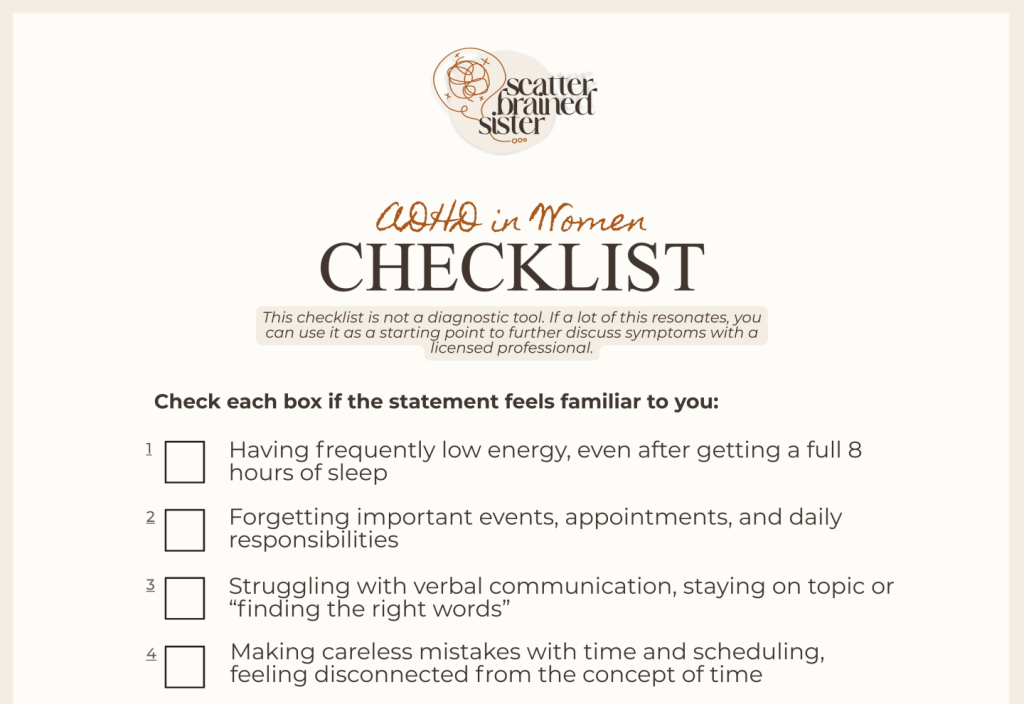
The 15 Symptom ADHD in Women Checklist
These are just some of the ways ADHD in women can show up in daily life. For a digital version you can mark up, share with your doctor, or keep for your records, download the full checklist below.
👉 Click here to download the FREE digital ADHD in Women Checklist
- Having frequent low energy, even after getting a full 8 hours of sleep
- Forgetting important events, appointments, and daily responsibilities
- Struggling with verbal communication, staying on topic, or “finding the right words”
- Making careless mistakes with time and scheduling, feeling disconnected from the concept of time
- Interrupting without meaning to, talking louder than you realize, reacting emotionally before you can regulate
- Needing background noise or stimulation to focus
- Missing bodily cues like hunger, thirst, or needing to use the bathroom
- Attempting to organize but never maintaining the systems you create
- Being seen as flaky or unreliable, even when you care deeply
- Getting into intense focus sessions that last hours and feel like a flow state
- Misjudging distances and spatial awareness (curbs hate to see you coming)
- Feeling persistently overwhelmed by self-care and maintenance tasks like hygiene or eating
- Feeling overstimulated and irritated after spending time in public spaces
- Taking longer to process emotions than the people around you
- Letting mail, taxes, and bills pile up even when you have the money to handle them
Disclaimer: The content on Scatterbrained Sister is for informational and reflective purposes only and isn’t a substitute for professional medical advice, diagnosis, or treatment. Always consult your healthcare provider with questions about ADHD or any other condition. These experiences are personal and may not apply to everyone.
When to Consider Getting Evaluated
Despite the multitude of reasons to seek a diagnostic evaluation, the most commonly shared in ADHD spaces is that life often feels harder than it should be, despite consistent effort. If you’re a woman questioning whether it’s worth mentioning ADHD, along with the checklist above, ask yourself these three questions:
- Do symptoms negatively impact your daily functioning? (This doesn’t mean everything is falling apart – it means you’re working harder than others seem to for the same results, or that everyday tasks feel unreasonably difficult)
- Have these patterns been present chronically, not just recently? (Especially before adulthood – ADHD doesn’t suddenly appear in your 30s, even if you’re only noticing it now)
- Do they create disruptions in your life? (This could be anything from frequently running late, to struggling with organization, to feeling constantly overwhelmed – it doesn’t have to be catastrophic to count)
Although these symptoms may not feel as obviously impairing because of their commonality, when combined and frequent, life can feel like Groundhog Day – where you can’t get a grip, and everything you try to sustain feels like sand slipping through your fingers. Reaching out for professional help can make a meaningful difference in how you experience life.

👉 Click here to download the FREE digital ADHD in Women Checklist
Takeaway
Everyone experiences sadness, but true depression is different and often debilitating.
The familiarity of these symptoms makes them easy to relate to, but considering the chasm in actual lived experience created by the frequency and severity of one’s symptoms. It’s one thing to lose your keys occasionally, but it’s another to lose track of your whole car multiple times a month because you can’t remember where you parked.
Diagnosis isn’t a solution, but it does open the door to understanding why things have been so challenging and puts you on the path to finding tools that actually work to make life feel much less overwhelming.